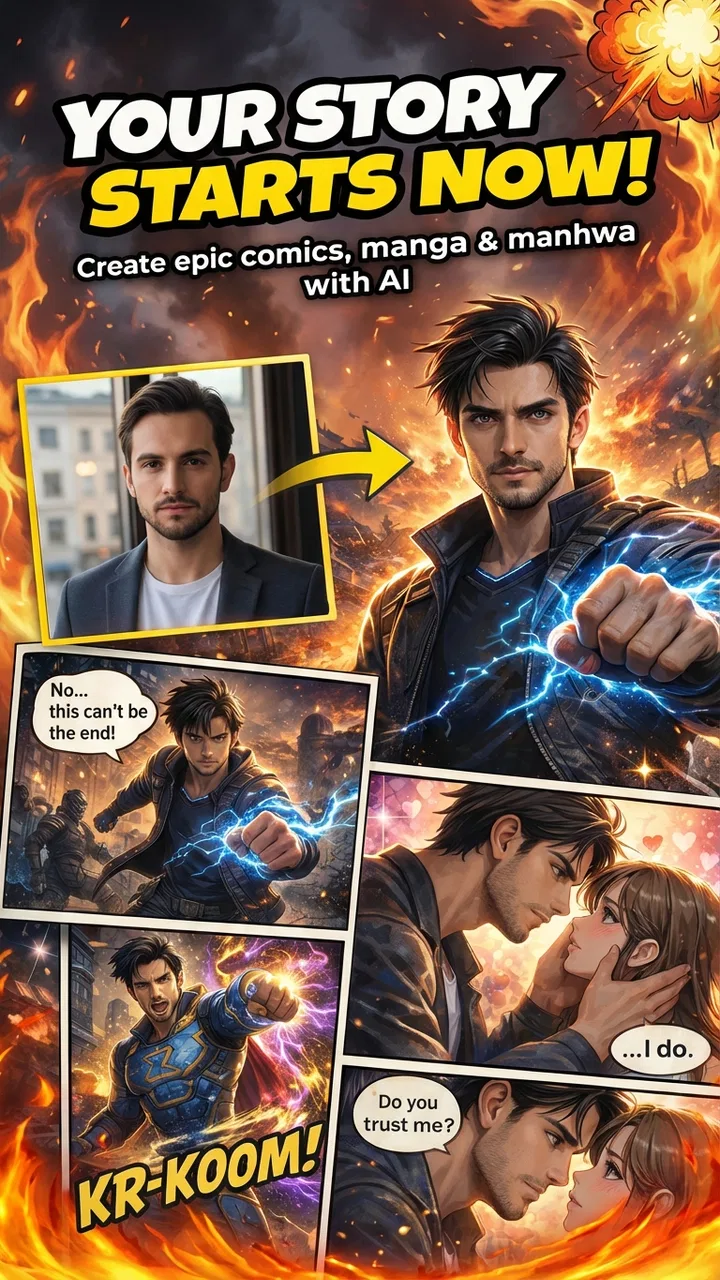
Comic Maker: AI Comic Creator
- 3.9
- Rating
- 10.00K
- Installs
- Free
- Price

 Analysis by App-foxy
I approached Comic Maker: AI Comic Creator as a tool for turning a rough idea into a readable comic, rather than as a full replacement for a professional illustration suite. Its place in the Comics category is easy to understand: the app is aimed at people who want to make manga-style pages, manhwa-inspired scenes, or cartoon panels without beginning every image from a blank canvas. In my experience, that makes it appealing for quick experiments, short stories, character concepts, and casual visual posts.
The important question is not simply whether it can help create a comic. It is whether the process feels manageable for different users and in different situations. I paid particular attention to how comfortably I could move through the creation workflow, how much precision it seems to demand, and whether the result remains usable when I am working on a small phone screen, in a noisy place, or with limited time. The outcome is useful, but it comes with trade-offs that are worth understanding before you commit to a longer project.
How comfortably the comic-making workflow can be followed
I look at the workflow here as a way to turn a story idea into a sequence of panels without demanding that I draw every element from scratch. That can make a first attempt feel approachable, but a comic still needs careful choices about reading order and legibility. The next section focuses on how I would shape a short scene so the making process stays manageable.
You May Also Like

 Blood Strike: 2.5 Anniversary
Blood Strike’s Loadouts Turn Every Drop Into a Tactical Gamble
A close look at Blood Strike’s custom loadouts: how fast access to signature weapons reshapes its battle royale rhythm, rewards preparation, and narrows the gap between fights.

 Pandora - Music & Podcasts
Pandora’s Music Is Easy to Start, but Harder to Recover
Pandora’s strength is its low-effort path from a seed to a station. Its weak spot is how much confidence it asks you to place in connection, setup, and quiet recovery.

 8 Ball Pool
 Is Built on Rivalries, Rematches, and Routine
A close look at the rivalries, rematches, shared routines, and unanswered safety questions that turn a quick pool match into a persistent mobile community.

 Samsung Music
’s Quiet Strength Is Playing What You Already Own
Its reach comes less from spectacle than from dependable access to a personal library. That simplicity is both the app’s strongest retention engine and its ceiling.

 AccuWeather: Weather Radar
AccuWeather Review: A Quick, Clear Forecast for Everyday Decisions
For everyday plans, the best forecast is the one you can understand quickly. AccuWeather makes rain timing, radar, and local conditions easy to act on, with a few trade-offs.

 Hill Climb Racing
Why Hill Climb Racing Still Turns Crashes Into One More Run
A tiny car, a bumpy hill and one more upgrade: Hill Climb Racing keeps resurfacing because its simple chaos makes every near-miss feel personal.
More From Our News Desk



Readability and navigation
The strongest part of the concept is its directness. A person who has never used a desktop drawing program can understand the basic purpose quickly: build a comic by combining characters, scenes, dialogue, and panels. That focus is less intimidating than opening a traditional illustration app filled with brushes, layers, paths, masks, and export controls. For a beginner, the narrower purpose can be a genuine advantage.
I found that the workflow makes more sense when I think in scenes rather than individual drawings. Instead of trying to perfect an entire page immediately, I can decide what is happening in one panel, place the visual elements, add the speech, and then move to the next moment. This is a useful way to break down a story for anyone who finds a blank page overwhelming. It also helps users who prefer a predictable sequence of small decisions.
That simplicity has a limit. Comic creation is not only about producing an image; it is also about controlling pacing, visual continuity, and the order in which the reader notices things. A guided maker can help with the first draft, but I would still review every panel as a reader. A character that looks fine in isolation may feel confusing when placed beside another scene, and dialogue that fits technically may still be too long for comfortable reading.
For readability, I recommend writing the dialogue before spending too much time on decoration. Short speech makes it easier to judge whether a bubble or caption is visually balanced. It also reduces the need to shrink text later. The most accessible workflow is to protect reading comfort first and treat visual polish as a second pass. That small change prevents a common problem in comic makers: attractive panels that are difficult to understand on a phone.
The app is published by LEBEDUSHKA, MCHJ XK, and its current version is 1.25.0. The version information is useful when comparing advice from other users, because instructions based on an older build may not match the controls or layout I see. The app requires Android 8.0 or later, so it fits a wide range of still-used Android devices, although the experience will naturally depend on the screen size and performance of the phone.
The public response is mixed but encouraging rather than overwhelming: it holds a 3.9 average from around two hundred ratings, with several dozen written reviews and over ten thousand installs. I read that as a sign of a developing product with a real audience, not as proof that every workflow will feel polished for everyone. The rating suggests that expectations matter. Someone looking for a fast creative starting point may be satisfied, while someone expecting the control of a mature desktop comic package may notice the gaps quickly.
Motor and sensory considerations
On a touchscreen, comic creation can become tiring when it requires repeated dragging, tapping small controls, or repositioning objects with fine accuracy. That matters for users with limited dexterity, hand tremors, joint pain, or fatigue. A template-based approach can reduce the amount of freehand precision required, which is one reason I see this app as more approachable than drawing every character and background manually.
There is still a difference between reducing drawing effort and removing motor demands. Selecting the correct object, adjusting its position, choosing a panel, and editing text can all require deliberate touch input. I would work in short sessions rather than trying to complete a whole chapter at once. Saving a rough version after each scene is also sensible, especially when a long sequence of tiny adjustments starts to feel physically uncomfortable.
Users with visual sensitivities should think about the style of their own project as much as the interface. Comic pages can become busy through strong contrast, crowded backgrounds, multiple speech bubbles, and rapid changes between panels. I found it more comfortable to keep a clear focal point, use fewer competing elements, and leave visible space around dialogue. These are design choices rather than special accessibility functions, but they make the finished page easier to scan.
For readers with low vision, the practical test is the final comic, not merely the editing screen. Text that appears acceptable while zoomed in may become too small when the page is viewed at its normal size. I would preview each page at the size a reader is likely to use and shorten dialogue instead of forcing smaller lettering. The app is best suited to creators willing to make those readability decisions themselves.
People who are sensitive to visual clutter may also prefer a restrained page structure. I would avoid placing speech over detailed backgrounds and would separate speakers clearly through bubble placement. This is especially important in a fast conversation, where the reading order can become ambiguous. A polished result is not necessarily the most decorated one; in this format, clarity often looks better than density.
For users who rely on hearing rather than visual cues, the finished product is naturally visual, so the creator should communicate meaning through expressions, captions, and clear action rather than assuming that sound would be available. For users who need text alternatives, the app’s usefulness will depend on how they plan to share and describe the finished work. I would prepare descriptive captions separately when publishing important visual information outside the comic itself.
Situational access in everyday use
A realistic use case is a student who thinks of a story during a commute, opens the app during a break, and builds one short scene before returning to work. That kind of session suits the product better than a long, uninterrupted illustration project. The app’s value is in lowering the distance between an idea and a visible draft. I can imagine using it to test dialogue, compare two scene arrangements, or show a friend the mood of a story before investing in detailed artwork.
It can also work for someone preparing a simple visual explanation. A short comic may be easier to follow than a block of instructions when the subject benefits from showing a sequence of actions. The creator still needs to keep the language concise and the order obvious, but the panel format encourages that discipline. This is one of the more practical uses beyond entertainment.
Working on a small screen changes the best approach. I would draft the story in a note first, then use the app for assembly rather than trying to compose plot, dialogue, and layout simultaneously. That reduces switching between mental tasks and makes a short session productive. It also helps users who become distracted by too many creative choices at once.
In a noisy environment, the app’s visual nature can be convenient because the core task does not depend on listening to audio. In bright sunlight, however, screen glare can make small controls and pale details harder to distinguish. At night, a busy or high-contrast page may feel tiring even if it looks dramatic. I would do the rough arrangement wherever convenient, then perform the final readability check in the conditions where the comic will actually be read.
For families, the Teen content rating is an important boundary. It does not automatically make every project appropriate for younger children, because the creator controls the story and imagery. I would treat the rating as a reminder to review the material and the way the app is being used, especially when a child is creating or browsing comics independently.
The app is free to install, which makes trying the basic creative idea less risky. It also includes in-app purchases ranging from $4.99 to $89.99 per item. That spread means I would explore the free experience first and decide whether the available tools justify spending before planning a serious series around it. A free starting point is helpful, but it should not be confused with unlimited access to every possible creation option.
Where the experience still creates barriers
The biggest barrier is the gap between a quick comic draft and a carefully controlled finished book. If I need exact character proportions, highly consistent costumes, precise lettering, or detailed panel choreography, a conventional drawing application may be the better choice. A dedicated desktop comic program usually offers more control over layers and page construction, while a vector tool is stronger when clean, scalable shapes matter most. This app is more attractive when speed and approachability matter more than microscopic control.
Another barrier is the need for personal quality control. A maker can help assemble a page, but it cannot replace the creator’s responsibility to check whether the story reads naturally. I would inspect the order of speech bubbles, the direction of movement, the contrast between foreground and background, and the amount of empty space. These checks are particularly important for readers who benefit from uncluttered layouts, because a confusing page can be much harder to decode.
There is also a cost-planning issue. Since optional purchases can reach a high amount for a single item, I would not treat every attractive extra as essential. First define the kind of comic you want to make, then identify which part of the workflow is actually blocked. If the problem is weak writing or unclear pacing, buying more visual material will not solve it. If the problem is limited variety in a particular project, then an optional purchase may be more relevant.
People who need strong support for assistive technology should test the app with their own setup before beginning a major project. I would pay attention to whether labels are easy to identify, whether touch targets are comfortable, and whether the editing sequence can be completed without relying on tiny gestures. I would not assume that a simple-looking interface automatically works equally well with every accessibility arrangement.
The same caution applies to long-form publishing. If the goal is a multi-page graphic novel with strict continuity, I would use this app for planning, thumbnails, or early visual exploration and keep a more controlled tool available for final production. Its convenience is most valuable at the beginning of an idea, while a larger project may expose the limits of mobile editing and consistency.
Who should use it, and who should choose another tool?
I would recommend it to a beginner who wants to tell a short visual story without learning a large illustration system first. It also makes sense for a writer who wants to test scenes visually, a teacher or presenter building a simple sequence, and a casual creator who values a quick result over complete artistic control. The combination of a free entry point and a focused comic workflow makes experimentation approachable.
I would be more cautious about recommending it to a professional illustrator, a lettering specialist, or anyone whose project depends on exact print preparation. Those users may become frustrated when they need fine-grained control that is normal in a full creative suite. The same is true for someone who dislikes touch editing or finds repeated small adjustments uncomfortable.
Compared with drawing from scratch, the app lowers the technical and time barrier. Compared with a general image editor, it keeps the comic structure closer to the center of the task. Compared with a professional desktop alternative, it is likely to feel more convenient but less exact. That positioning is the key to judging it fairly: it is not trying to be every kind of art tool at once, and I would get the best results by using it for the part of the process it handles most naturally.
My inclusive verdict after using the app
Comic Maker: AI Comic Creator is a practical starting point for mobile comic experiments, especially when the creator needs help moving from an idea to a sequence of readable panels. I like that it encourages scene-based thinking and avoids the intimidation of a completely blank illustration workspace. For users with limited drawing confidence, that can be the difference between abandoning an idea and producing a first draft.
Its accessibility story is more about reducing complexity than offering a complete set of specialized accommodations. Users with different motor, visual, sensory, or situational needs can improve the experience through shorter sessions, simpler layouts, concise text, and careful previews, but those adjustments require active involvement from the creator. I would not call the app universally effortless; I would call it flexible enough to be useful when the project is kept focused.
My final advice is to begin with one short scene, not a full series. Check how comfortably you can select, arrange, and edit elements on your device. Then read the finished page at its normal size and ask whether someone unfamiliar with the story can follow it. If that small test feels natural, the app may become a pleasant creative companion. If you need exact production control, extensive page management, or a workflow built around assistive tools, a more specialized alternative will probably serve you better.
Overall, I see this as a free-to-start comic maker for accessible experimentation rather than a complete professional studio. Its 3.9 average reflects a product that can be useful while still leaving room for refinement. I would recommend trying it with modest expectations, protecting readability at every stage, and spending only when a specific project genuinely needs an optional addition.
FAQs for Comic Maker: AI Comic Creator
01What is Comic Maker: AI Comic Creator?
Comic Maker: AI Comic Creator is an innovative app that allows users to easily create their own comic strips using AI technology. It offers a variety of templates, characters, and scenes, making it accessible for both amateur and professional comic creators. The app is available for both Android and iOS devices.
02How user-friendly is Comic Maker: AI Comic Creator for beginners?
Comic Maker is designed with user-friendliness in mind, featuring an intuitive interface that simplifies the comic creation process. Beginners can easily navigate through the app, thanks to step-by-step tutorials and tooltips that guide users through each feature, from selecting characters to adding dialogue.
03Does Comic Maker: AI Comic Creator require an internet connection?
While Comic Maker offers offline functionality for basic features, certain advanced tools and updates require an internet connection. This includes accessing the latest templates and character packs, as well as using AI-driven features that enhance comic creation with smart suggestions and edits.
04Are there any costs associated with using Comic Maker: AI Comic Creator?
The app is free to download, but it includes in-app purchases for premium features, such as exclusive templates and characters. Users can choose to subscribe to a monthly or annual plan to access all premium content and remove ads, enhancing the overall comic creation experience.
05What are the export options available in Comic Maker: AI Comic Creator?
Comic Maker allows users to export their creations in various formats, including high-resolution images and PDF files. This flexibility makes it easy to share comics on social media, print them, or use them in presentations. The app ensures that exported comics maintain high quality, preserving the creator's vision.
Pros
- User-friendly interface for easy comic creation.
- Variety of templates to spark creativity.
- Supports exporting in high-quality formats.
- AI-powered suggestions for story enhancement.
- Regular updates with new features and fixes.
Cons
- Limited free version with in-app purchases.
- Occasional crashes on older devices.
- Requires internet for some features.
- Some templates lack customization options.
- AI suggestions sometimes feel repetitive.

Comic Maker: AI Comic Creator
Gallery